
Physiotherapy
Indiba® (capacitive-resistive radiofrequency): what it is, what it is used for and what the evidence says
What Indiba® radiofrequency is, how it is used in physiotherapy, what the research shows and how we use it at IME in La Ràpita, Spain.
7 November 2026 · Author: Medical team at Institut Mèdic Especialitzat La Ràpita
See a specialist in La Ràpita

Alba Gil Carles
Physiotherapist
IME physiotherapist (registration no. 12545). Muscle strains, sprains, tendinitis, sports injuries, neck pain and jaw (TMJ) problems.
Book your visit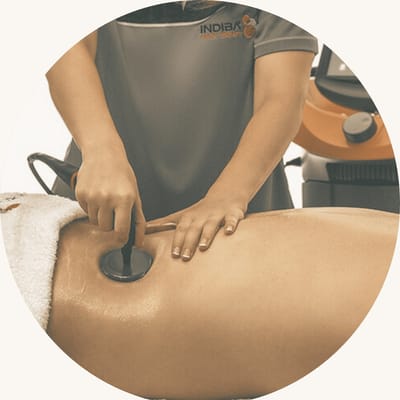
Indiba® is the brand name of a radiofrequency device used in physiotherapy. The technique is known as capacitive-resistive electric transfer (CRET, sometimes called “Tecar therapy”). At Institut Mèdic Especialitzat La Ràpita (IME) it is part of the sessions offered by our Physiotherapy service, always alongside manual therapy and exercise, for patients across Montsià and the Terres de l’Ebre area. To book: +34 697 38 07 86, WhatsApp or Doctoralia via our contact page.
What is capacitive-resistive radiofrequency?
It is a form of diathermy: an electrical current oscillating at high frequency passes through the tissues and generates therapeutic heat (De Sousa-De Sousa et al., 2021). It uses long-wave radiofrequency of around 0.5 MHz. The device has a neutral plate and two types of electrode, so energy can be delivered in two modes: capacitive and resistive (Beltrame et al., 2020).
Across the studies reviewed, the most common frequency was 448 kHz, although very different frequencies have been tested. The temperature rise is not limited to the surface: it has been recorded up to 20 mm deep, and in one study it was greater and longer-lasting in resistive mode than in capacitive mode (De Sousa-De Sousa et al., 2021).
What effects does it have?
Studies describe higher skin temperature, increased blood flow in skin and muscle, and higher haemoglobin oxygenation (De Sousa-De Sousa et al., 2021). On that basis it is used to ease pain and help movement during recovery.
What is it used for?
In the research literature it has mainly been used for (Beltrame et al., 2020; De Sousa-De Sousa et al., 2021):
- Back pain and other spinal problems.
- Knee osteoarthritis.
- Musculoskeletal and sports physiotherapy.
- Pelvic floor and sexual dysfunction.
- Skin-related (dermato-functional) physiotherapy.
What does the evidence say?
This is where it pays to be clear: there is evidence, but it is limited and of variable quality.
| Review | Findings |
|---|---|
| Systematic review of 13 studies (Beltrame et al., 2020) | Almost all reported less pain and better function after treatment, but of the 9 randomised trials only 2 had a low risk of bias. The authors call for more standardised protocols. |
| Review of 30 studies in physiotherapy and sport (De Sousa-De Sousa et al., 2021) | “Good/fair” methodological quality, but the studies were too different to combine in a quantitative analysis. More research is needed. |
| Meta-analysis on musculoskeletal pain (Vahdatpour et al., 2022) | Less pain than control groups at 4 and 8 weeks, with very high heterogeneity between studies. |
| Review of 68 diathermy studies, including CRET (Pollet et al., 2023) | Most pooled analyses showed no significant improvement and the evidence was of low or very low quality; the authors do not recommend diathermy over better-supported therapies. |
In practice, this means Indiba® may help some people manage pain, but it should not replace better-supported treatment. That is why at IME we use it within a plan that includes assessment, manual therapy and exercise, never as a stand-alone treatment.
What is a session like?
- The physiotherapist first assesses the injury and checks there is no reason not to use the technique.
- The neutral plate is placed and the physiotherapist applies the electrode over the area being treated.
- Most people feel gentle warmth; tell your physiotherapist if it becomes too hot.
- At IME, physiotherapy sessions are one-to-one, last 45 minutes and combine radiofrequency with manual therapy and exercise as planned.
On safety, the studies reviewed provide little data; those that report it describe no adverse effects (De Sousa-De Sousa et al., 2021).
Indiba® at IME in La Ràpita
IME’s Physiotherapy service works to a plan coordinated with the centre’s orthopaedic surgeons and has a rehabilitation gym, Indiba® and pressotherapy. We are at Av. del Dr. Ferran, 73, 43540 La Ràpita, and also see patients from Amposta, Tortosa, Deltebre, Alcanar, Sant Jaume d’Enveja, Ulldecona and Vinaròs. For pelvic floor problems, see our pelvic floor physiotherapy service.
Frequently asked questions
Does Indiba® hurt?
Most people simply feel gentle warmth in the area. If it becomes uncomfortable, the physiotherapist adjusts the intensity.
How many sessions will I need?
It depends on the injury and how it progresses. There is no fixed number: it is decided at your assessment and reviewed during treatment.
Does it replace exercise?
No. On current evidence, radiofrequency is an add-on. Exercise and manual therapy remain the foundation of your recovery plan.
Can I use my health insurance?
If your policy covers physiotherapy, ask us how to combine it with the centre’s plan. Cover depends on each insurer.
Would you like an assessment? Book your visit
A consultation is the way to find out what is right for you. Book online or call us and we will tell you the next clinic day.
Alba Gil Carles
Physiotherapist
IME physiotherapist (registration no. 12545). Muscle strains, sprains, tendinitis, sports injuries, neck pain and jaw (TMJ) problems.
Doctoralia ratings checked on 8 November 2026.
References
- Beltrame R et al. Capacitive and resistive electric transfer therapy in rehabilitation: a systematic review. Int J Rehabil Res. 2020. PMID 32909988
- De Sousa-De Sousa L et al. Application of Capacitive-Resistive Electric Transfer in Physiotherapeutic Clinical Practice and Sports. Int J Environ Res Public Health. 2021. PMID 34886180
- Vahdatpour B et al. Effects of Transfer Energy Capacitive and Resistive On Musculoskeletal Pain: A Systematic Review and Meta-Analysis. Galen Med J. 2022. PMID 36698689
- Pollet J et al. The Efficacy of Electromagnetic Diathermy for the Treatment of Musculoskeletal Disorders: A Systematic Review with Meta-Analysis. J Clin Med. 2023. PMID 37373650
The information on this website is for general guidance and does not replace an assessment by a healthcare professional. In an emergency, call 112.